
It’s 9:45 PM last Friday. Eric Schmidt steps up to the podium to address the University of Arizona Class of 2026. (What an absolute rager.)
He's a few minutes into his remarks when he mentions, "Last December, Time Magazine selected its person of the year for 2025. And this time it was the architects of artificial intelligence. Interesting—"
"BOOOO!" Schmidt is interrupted by an echoing cacophony of boos from the graduates.
He attempted to empathize, rattling off every reason they had to fear AI — "the machines are coming... the jobs are evaporating... you are inheriting a mess that you did not create."
Shockingly, it did not go well.
This wasn't an isolated incident. A week earlier at UCF, a real state exec called AI "the next industrial revolution" at the humanities graduation and someone yelled "AI SUCKS!" Days later, at Middle Tennessee State's commencement, Scott Borchetta — CEO of Big Machine Records (Taylor Swift's former label) — was booed when referring to AI. His response "Deal with it. Like I said, it's a tool." (So are you, Scott.)
Each speaker thought their inspirational message about how AI would shape the students' future would land. It did not. The future generation instead interrupted their most important milestone to date to shit on the thing that's supposed to revolutionize society.
The vibes are off with AI. The median first impression of AI is bad: Google AI Overviews telling you to drink bleach, low effort AI generated content that's tantamount to art theft, Apple Intelligence (yikes). Much of it was foisted upon the user without consent, with no ability to opt out.
Consumer AI was deployed as a growth lever before it was a trustworthy product and your customers know it.
I see the AI vibes from three different Internets.
One is my LinkedIn feed first thing in the morning, where one person is announcing "My current career retirement plan: Build a B2B AI SaaS, exit for $5M, and retire before AGI makes my entire profession obsolete." Another is an AI training company reposting celebrations of SWEs being accepted as an AI trainer (to make their profession obsolete).
The second is the consumer Internet, where my Instagram algorithm serves me an AI bro "creator" breathlessly hyping GPT-5.5 (it's an ad) followed by a cocktail BTS video captioned "Showing the BTS on a shoot used to be bonus material. Now it's essential to prove you're not a soulless hack job."
The third bubble lives in my group chats and real-life, where my non-tech industry friends oscillate between bemoaning the proliferation of AI Super Bowl ads and goading a custom AI chatbot into roasting a fantasy football league member's draft picks.
Each of those bubbles is right about something, but the contradictions can't be ignored, especially if you're building in consumer AI.
I've spent nearly the last decade working in monetization, managing the delicate balance of customer empathy and revenue OKRs. Trust is carefully earned, and easily broken—especially when you're billing someone $23 + tax (yikes) for their HBO Max subscription every month.
I've also spent the last 25 years obsessed with movies. I pay attention to the craft and I mourn the uptick in ridiculous IP farming. (Although the Hungry Hungry Hippos horror movie looks like a banger.) While I don't claim to be a creative, I empathize with the virulent AI pushback of filmmakers and other creatives.
This piece is me trying to hold all of those ideas and understand what customer empathy looks like in the AI product age. I'm bringing you three perspectives: the Reddit outrage factory, the thoughtful AI skeptic, and the implication for building a product that consumers don't reject.
Pitchforks and Torches
It surprised me to discover that the median emotional tone on Reddit was not abstract rage against the techno machine, but one of betrayal, trust erosion, and frustration over an imposed dependency on AI.
Verasight's 2026 AI adoption report puts monthly U.S. AI use at 64%, with half using it weekly. Pew found that most Americans are also more concerned than excited about AI's impact on daily life.

Americans are freaked out by AI. (Source: Pew)
Much of the online discourse centers on three trust break waves by OpenAI/ChatGPT.
The first, in April 2025, surrounding the release of GPT-4o. The model was derided by users for fueling "AI sycophancy" including one viral Reddit post where the chatbot encouraged a user to spend $30K to launch his (literal) "shit on a stick" business idea.
The second, when GPT-5 launched in August 2025 and users loudly complained about the "bait and switch" of OpenAI removing access to previous models.
The third transcended Reddit rage into monetization mayhem (i.e. real cancellations) for OpenAI. Anthropic refused a Pentagon contract over red lines on mass surveillance and autonomous weapons. Sam Altman publicly said OpenAI shared those red lines — and signed the same DoD contract hours later.
Time to cancel ChatGPT Plus after three years. Anthropic got nuked for having ethics, and Sam Altman instantly swooped in for the Pentagon bag.
The consequence of these trust breaks is grief laced with betrayal. These customers were sold on something, eagerly adopted the product, then at each of these points, they perceived a gap between what was promised and what was delivered.
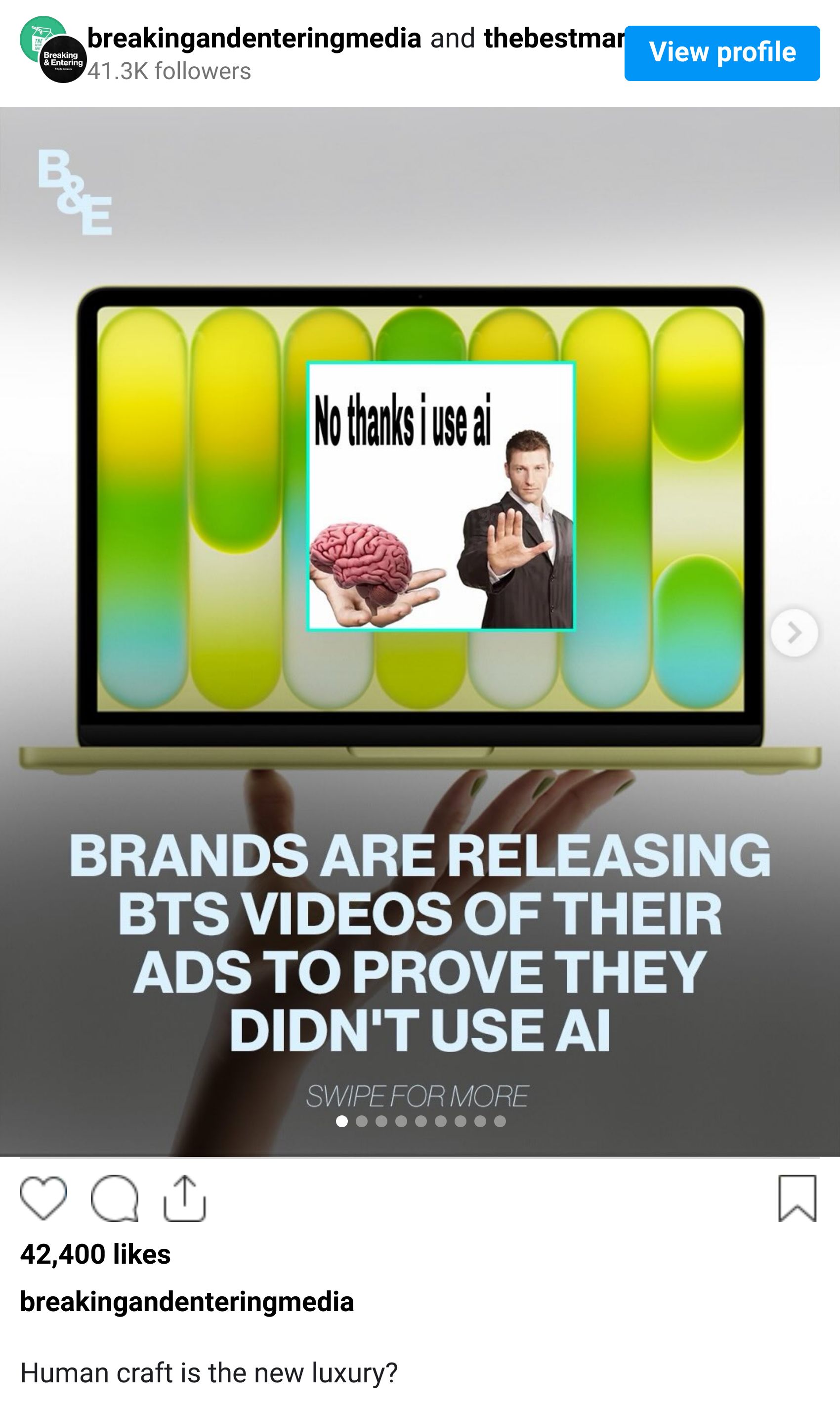
Beyond user trust, the creative class and their sympathizers are righteously indignant about the proliferation of AI slop and IP infringement. The Oscars have (rightly) drawn a hard line, banning the use of AI in acting and writing categories. Joseph Gordon Levitt is on a (500+) Days of Shitting on AI Theft beat. Millennials and Gen Z have their guard up, with comments sections quick to jump on content created by AI. This has manifested in a consumer premium for authentic content: brands are even releasing BTS videos of their ads to prove they didn't use AI.
Another prominent theme is AI-induced cognitive decline. There are numerous accounts of people feeling like "ChatGPT made them dumber" or feeling overly reliant on it. This is seemingly backed by research: a widely cited (albeit limited sample size) MIT study last year indicated that 83% of essay writers using ChatGPT were unable to recall a single line they had written.
People feel like AI has been foisted upon them, with no ability to opt out. Some of the biggest perpetrators of this are the Big Tech players that have consumer surfaces across every aspect of our lives—Meta injecting AI into search bars across every app, Google AI Overviews spewing millions of confident hallucinations everyday, and Apple Intelligence overpromising and drastically underdelivering.
A final source of outrage is the physical manifestation of AI. Depending on where you live, it might literally be in your backyard. Though the "each AI query uses a bottle of water" stat is basically complete bullshit, the localized water strain from data centers is real. In one instance, a Georgia data center secretly drew nearly 30M gallons of water during drought conditions and the county couldn't fine them because "They're our largest customer, and we have to be partners. It's called customer service."
The consumer AI backlash isn't all irrational, but the call is coming from inside the house. The LLM daily active users are the ones recognizing that it's being deployed recklessly as a growth lever—in areas where it isn't reliable, where it degrades skills or ownership, and bolted on without consent or an escape hatch.
But Reddit isn't the whole Internet, and Instagram isn't exactly known for nuanced opinions.
A music producer, a Fortune 500 professional, and a healthcare exec walk into a bar
I talked to three people who don't work in tech, don't subscribe to 13 AI newsletters, and are using these tools anyway.
Friction is the product. Luke—a music producer who uses ethically-licensed AI in his work—tells me that he lived through the evolution of cassette tape to CD to iPod to the entire history of music streaming with the click of a button.
Now he's witnessing the vinyl resurgence. "I think for someone to purchase vinyl at a show, these people are walking away as fans with a piece of art. Yet it's more expensive. It doesn't sound better. It doesn't make things easier. It's the opposite of that." After decades of disinterest, people are buying vinyl again—because the friction is the product.
Kunal—a rigorous ex-banker turned healthcare corp dev exec—hits on the same point. "For something like a marathon, which requires hours and hours and a huge commitment of your life, I don't like the idea of relying on AI because you need to build the neural network in your head." He likens it to the "sweat equity" he built churning decks in consulting and banking. He wants the friction for the learning to feel earned and to stick.
Mike*—corporate employee at a Fortune 500 retailer—is neutral on AI. He used ChatGPT for a bachelor party Costco shopping list and a market-pricing zone structure at work. On Google's AI shift: "I'm essentially using Gemini now. I didn't make that choice, but it's happened." These are all low friction tasks, and friction isn't really the point. Every consumer AI company is selling transformation. Mike got a grocery list. Ambivalence is the most damning consumer review possible.
*Pseudonym used at their request.
Trust is earned by showing. "I feel like I'm talking to a computer that doesn't know its limits" is how Kunal framed his uncertainty when using AI for work. His trust lives on a spectrum. Interpreting contracts? Solid. Executive decks? Not so solid.
Kunal formed his own taxonomy that specifically hits on the trust and transparency issues felt by AI users: tasks with a rubric are great, while tasks requiring judgment and framing fall short. In one case, he can transparently track the inputs to the outputs. In the other case, he can observe a tangible problem, but doesn't know how it arrived at that point.
Luke hits on a similar topic when describing his mental model for using certain AI tools and not others: "whether that product was trained ethically."
On Suno (an AI music generator): “I’m pretty sure that my music as well as hundreds of thousands of other creators over time have been used to train that model. Probably illegally and unethically.”
Contrast to Sound ID Voice AI (a studio-grade AI voice changer plugin): "I've used it on a daily basis over the last few months... They've trained models of different people's voices with their consent."
Trust is earned through transparency—when the training inputs are known and when the outputs are more predictable.
What AI replaces matters. There's nuance to AI's perceived seat at the table. It ultimately seemed to come down to the stakes.
Kunal uses ChatGPT "in all sorts of ways—ideas on how to entertain my kids... questions on taxes... a unique idea for an anniversary." These are relatively low stakes. If AI didn't provide the answer, the counterfactual is adulting avoidance. No one really loses.
Similarly, Luke waves away AI taking the type of work where "[producers] use 49 different songs on this 30 minute episode of an MTV show, and it's like 12 seconds of each." There is little craft here, it just fills the void.
When I asked Luke if he's bothered by a 14-year old kid using Suno to make his friend a birthday song, he told me genuinely "I think that's honestly a cool use... it's almost like an introduction to creativity." Again, AI has no commercial impact. Where nothing would have existed, AI is welcome.
Adoption under duress. Our three voices converged on their shared existential fear of falling behind.
Kunal feels career pressure. "If I don't use it now, I'm gonna be a dinosaur, and it's gonna show day by day. And especially at my level, where perceptions matter." He goes on to reassure me that he believes in the AI workforce enablement future: "I can't be like the guy who said email is crap in 2000. This is not like me denying NFTs are a thing."
Mike feels organizational pressure. "It's like, don't get left behind, so you better start figuring some of it out. And the time you spend figuring out isn't really making up for the time, from an opportunity cost standpoint, of what you could have been doing otherwise. It's almost an investment more so than a productivity win at this point."
Luke feels industry pressure. "I try to spend a little time with a lot of these tools as they come out and just see, you know, I also don't want to be left behind, but I really don't want to be using them necessarily in my finished products."
Three practitioners in vastly different fields, none of whom are AI enthusiasts. They all have one thing in common: they're using AI as a hedge against irrelevance.
The humanity premium. One story Luke shared underscored a recurring theme across this entire research effort: people put a premium on the human touch.
"This EDM song started kind of popping off on TikTok. And as it got a little bigger, people kind of started to question, is this artist real?" And the EDM community — a genre built on synthetic sound — shut it down. "No, we're not doing this. This isn't okay. That's AI. We don't like this."
Luke's retrospective read: "the main reason I think people are going to these shows isn't to necessarily see DJ A or DJ B. It's like I'm experiencing this with all these other people and they're real people. That's what's fire about it."
He goes on to predict that the advent of AI tools like Suno and the loss of the craft will have an unexpected outcome. "I think it's going to bring the rock star back."
If you're building consumer AI, the lesson isn't "add humans back." It's that you have a narrower path than you think.
Negotiating the hostage situation
If you're wondering how to build in a semi-hostile marketplace, start from a place of customer empathy. Before you ship, ask four questions:
What's the counterfactual? If the alternative is nothing, AI has latitude. If you're replacing a paid professional, the bar is higher. Clearly disclose AI and keep the human in the loop where appropriate. Gmail Smart Compose confidently suggests full phrases inline. Low stakes: the alternative is slower or less precise writing.
Did they opt in? If the feature appears uninvited, you have a higher burden of proof to establishing trust. Build trust with the user by allowing them to develop an intuition on the data, then introduce AI once they have confidence. Google Photos introduced AI in stages — first face grouping, then Memories, then natural language search — years after establishing trust by organizing and storing photos.
Can your user see the inputs? If the user can't trace how you got there, you're asking them to trust a black box. Show your work. Customers love Perplexity because it cites sources with direct links. It's auditable, not authoritative.
What happens when it's wrong? If the answer is: nothing, you don't have a corrective path. Make having one a default. ChatGPT, Claude, and Gemini all have a "regenerate" and thumbs up / thumbs down buttons on their answers. An individual can retry and the overall product gets better for it.
A music producer, a Fortune 500 professional, and a healthcare exec walk into a bar... and agree with Reddit? "Interesting."
When most of your product category is regarded with a mix of frustration, ambivalence, and powerlessness, you might want to rethink how you're considering the customer.
A simple heuristic of "would this feature retain users if a compelling alternative existed?" is the right first step.
If the answer is no, you don't have a product, you have a hostage. Hostages don't churn in the short run, which is why failure is invisible on the dashboard.
The Recipe

AI is not a water bottle.
Too much: AI doomerism laundered through bad data. Each ChatGPT query uses a bottle of water. (Off by 1000x in places.) ChatGPT uses 10x more energy than a Google search. (Nope, it's about the same.) AI data centers will consume 1.7 trillion gallons of water by 2027. (Only 3% drinkable water, and 90% will not be "consumed.")
Not enough: Discussion of the local impact. "In Ashburn, VA... they're offering an entire neighborhood four million dollars to move out of their homes so they could raze the entire neighborhood for a data center." (Mike, from earlier.) Lake Tahoe's decades-long-energy-partner is going to jump ship in May 2027 to power data centers at Google, Apple, and Microsoft's behest. ("No friends on powder days" taken to the logical extreme.)
What’s the fix? The meta hand wringing lacks nuance. Worse, it provides a straw man for AI apologists (and investors) to easily tear down to avoid the uncomfortable questions about the impact of AI infrastructure on our neighborhoods. The viral stats are wrong. The neighborhood-level impacts are real. Understanding this is the starting point to having this discussion credibly.
The Garnish

“My brain has just one cell, and I know why / Because of AI, because of AI, because of AI…"

Colombia Business School’s students took no prisoners with this video. There’s some inside baseball here, but overall, it’s pretty universal.
I’m a sucker for a good song parody. I produced Texas MBA Revue (a self-deprecating variety show in the week leading up to graduation) in 2017. Real respects real.
Do me a favor and click through to this video. You won’t regret it.
Source: CBS Follies
Product Cocktail
Tip Your Bartender
Send me questions, feedback, and cocktail recipes: [email protected]
Icons made by Icongeek26 from www.flaticon.com.